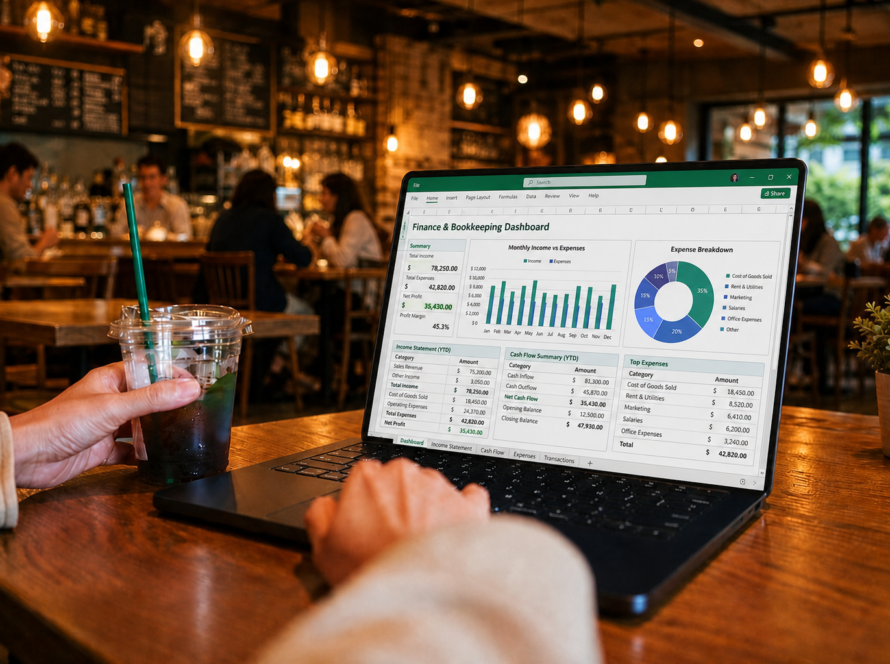
Running a small restaurant is a labor of love, but let’s be honest: nobody opens a kitchen because they are excited to reconcile spreadsheets.
Yet, in an industry where average profit margins hover between 3% and 5%, financial visibility isn’t just a back-office chore—it’s your survival mechanism.
If your current bookkeeping strategy involves a literal shoebox of crumpled thermal receipts and a monthly panic before sales tax is due, this guide is for you. Here is how to streamline your small restaurant bookkeeping without losing your mind.
The Core Metrics: What Are You Actually Tracking?
In retail or e-commerce, basic bookkeeping is straightforward. In the restaurant world, things move fast, inventory spoils, and your labor fluctuates by the hour. To truly understand your cash flow, your books need to measure Prime Cost.
Prime Cost = Cost of Goods Sold (COGS) + Total Labor Costs
Your Prime Cost is the heartbeat of your restaurant. Ideally, a healthy small restaurant should keep this number under 60-65% of total revenue. If your bookkeeping process only calculates this at the end of the month, you are diagnosing a problem weeks after it already cost you money.
Build Your Daily, Weekly, and Monthly Routine
The biggest mistake small restaurant owners make is letting the paperwork pile up. Bookkeeping is much easier when broken down into manageable bites.
1.Daily Tasks: Sales & Cash Verification:10 minutes.
Match your daily Point of Sale (POS) reports against actual bank deposits. Code cash drops, credit card batches, and third-party delivery payouts (like DoorDash or UberEats) immediately to catch discrepancies early.
2.Weekly Tasks: Accounts Payable & Mini-Closes:30 minutes.
Log your vendor invoices weekly. Don’t wait until the end of the month to see if the price of chicken breast or paper packaging spiked. A weekly review lets you adjust your menu prices before your margins erode.
3.Monthly Tasks: Bank Reconciliations & P&L Analysis:1 hour.
Reconcile your bank, credit card, and loan statements. Generate your Profit & Loss (P&L) statement and break down your expenses to see exactly where your revenue went.
Ditch the Manual Entry: Connect Your Tech Stack
If you are still typing daily sales entries into a spreadsheet by hand, you are wasting valuable hours and risking costly data-entry errors.
The modern hospitality business relies on automated integration. Your bookkeeping system should function as a unified ecosystem where your core software speaks to each other:
|
System Type
|
What it Handles
|
The Golden Integration
|
|---|---|---|
|
Point of Sale (POS)
|
Daily sales, guest counts, payment methods
|
Direct mapping to cloud accounting
|
|
Scheduling Software
|
Employee clock-ins, shift planning, labor metrics
|
Syncs with sales to show real-time labor percentages
|
|
Cloud Accounting
|
General ledger, automated bank feeds, sales tax tracking
|
Automatically pulls data from POS and Bank Feeds
|
By directly linking a platform like Toast or Square to QuickBooks Online, your daily sales journals are generated automatically while you sleep.
Keep Tip Allocation and Payroll Clean
Payroll is a massive compliance minefield for small food businesses. Between hourly front-of-house staff, salaried kitchen managers, tip pools, and credit card tip withholdings, manual calculations are a recipe for a Department of Labor audit.
Ensure your bookkeeping structure splits labor into clear categories:
- Front-of-House (FOH) Wages
- Back-of-House (BOH) Wages
- Management Salaries
- Taxes and Payroll Overhead
Tracking these separately helps you pinpoint exactly which department is over-extended when labor costs spike.
Stop Counting Pennies, Start Growing Profits
The goal of clean bookkeeping isn’t just to stay compliant with the tax authorities—it’s to give you the data you need to make confident business choices. When you know your exact food costs, labor percentages, and daily margins, you can engineer your menu for maximum profit.
If you are stretched too thin running shifts to manage the back office, you don’t have to tackle it alone.
Ready to graduate from messy spreadsheets to a flawless, automated financial workflow? Let’s get your books working for you. Visit us at Rescountant to streamline your restaurant’s financial strategy today.
Contact Us For A Free Consultation